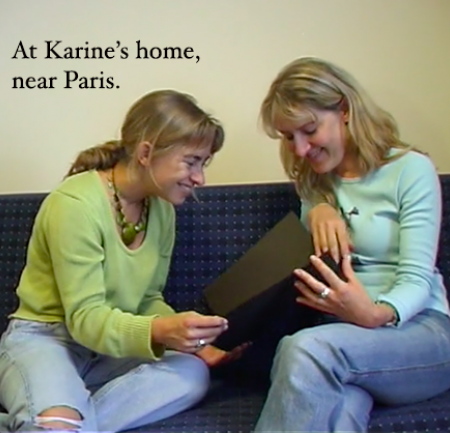
Claire : You called me about both of us going to Scotland.
  But why? You told me about a painting, but where is it?
  Can I see it?

  Karine : Yes, you can. Here it is. What do you
  think?

  Claire : Well, I don’t know. What about you?

  Karine : I think I know him. Don’t you think
  there is a sort of likeness between us?

  Claire : Well, apart the skirt… his face is ….

  Karine : It isn’t a skirt, it’s a kilt. Scottish
  men’s clothes. You know the Scots and the Bretons
  are very close, like « cousins ». Maybe he’s one
  of my family, an ancestor of mine.

  Claire : So you want to go to Scotland to look for
  your ancestors. Ok, I agree. Shall we go?

  Karine : Yes, let’s go.
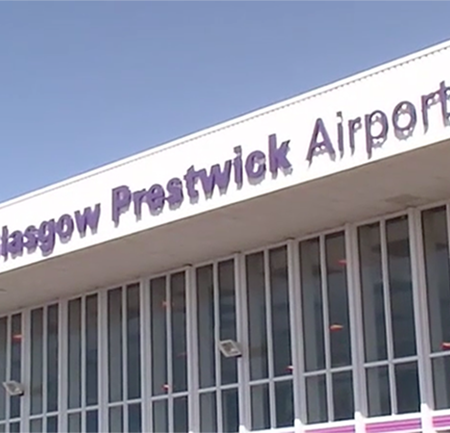
               In Glasgow, Scotland

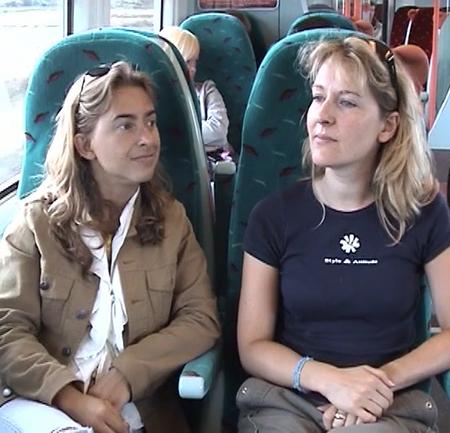
  Claire : so, we’ve landed safely, haven’t we?

  Karine : Yes, and it was fast. A one and half hour
  flight, that’s convenient.

  Claire : The train will take us to Glasgow.

  Karine : I’ve never been to Glasgow, have you ?

  Claire : Yes, I have, once, some time ago.

  Karine : Is it a nice town?

  Claire : There’s nothing particularly interesting
  about it. I like Edinburgh better; with its old
  castle.

  Karine : I’m impatient… The train, the train is
  coming….
  Claire : It isn’t cold.

  Karine : No, it isn’t. It’s fine, I feel… It must
  be about 22 degrees.

  Claire : I’d say 20.

  Karine : I’m just wearing a tee-shirt.

  Claire : yes, it’s sunny and there are no clouds.
  It’s half past twelve in France, what time is it
  in England?

  Karine : There is a one hour gap, it’s half past
  eleven.

  Claire : So, there is one hour less, it’s earlier.

  Karine : Yes, it is. England is more to the west
  of France. Likewise Scotland, there is a one hour
  difference.

  Claire : We must change the time on our watches.

  Karine : I haven’t changed mine yet. I’d better do
  it now.
Visit Glasgow with Gordon and Billy CONNOLY
(and love his wonderful Scottish accent).

Subtitles are available by clicking on the icon,
or choose subtitles in "parametres":

https://www.youtube.com/watch?v=h-GkAsPP6Zw

Malheureusement, la traduction automatique ne
comprend pas bien l'accent de Billy CONNOLY
et il y a donc quelques erreurs de traduction :
ainsi le mot "Glasgow" n'est pas reconnu.
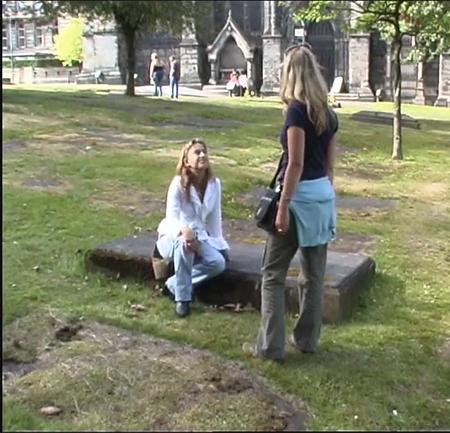
  Karine : This cathedral was built in the 12th
  century. It’s not the original building on
  this location. The first one was built at the
  end of the 6th century. But it was destroyed.

  Do you know that a monk, Saint Mungo, created
  the town of Glasgow, and he was buried somewhere
  here?

  Claire : Oh yes… they are tombs, not like
  in France.

  Karine : It’s a nice green place here, isn’t it?

  Claire : yes, it is.
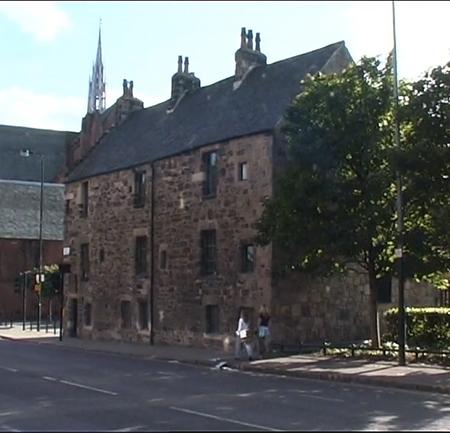
  Claire : I think this is it. Yes, I think it’s
  the oldest house in town.

  Karine : It’s more than five hundred years old.
  It was built in 1471.
  It was built for an abbot called Murhead.

  Claire : The word Glasgow means green place
  in Gaelic. It’s a very old language, similar
  to that of Brittany.

  I thought Glasgow would be polluted, but it’s
  quite green, isn’t it?

  Karine : First of all, Glasgow was a harbour,
  with ships trading with America. This is why
  the town expanded. There was a shipyard on the
  river Clyde, then came the train industry.


       Visit the oldest house in Glasgow:
  https://www.youtube.com/watch?v=XmqvMlMLnB4&t=125s
  Claire : Where are we going to now?

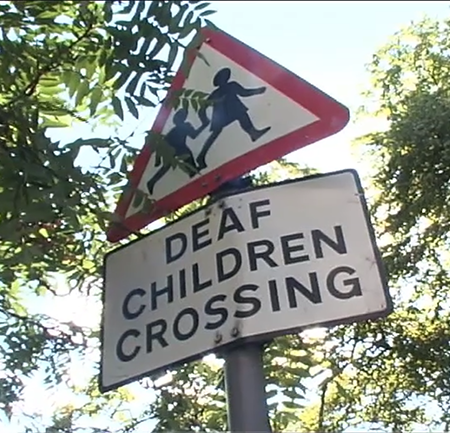
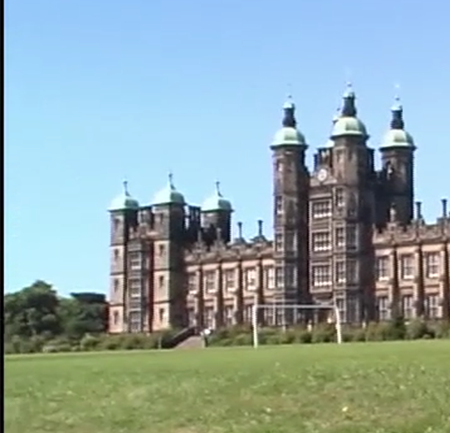
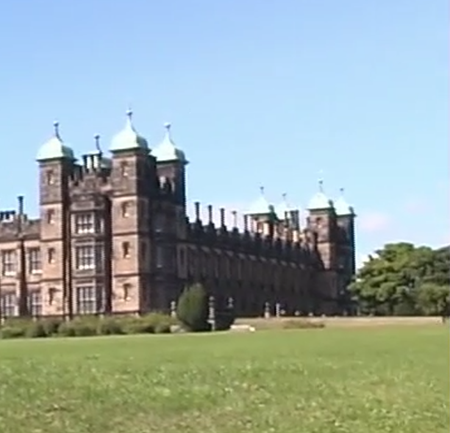
  Karine : We’re going to Donaldson’s
  school.

  Claire : Yes, I’ve heard of it. It’s
  the Edinburgh school for the deaf.
  But why go there?

  Karine : Because the school is going
  to move from here, in two years time.
  Maybe my ancestor was deaf like me. Maybe
  he studied in that school.

  Claire : Or maybe he was a teacher there.

  Karine : I don’t think so, there were no deaf
  teachers at that time. Do you know why this
  school is called Donaldson’s?

  Claire : Yes, I do. I’ve heard the story.
  James Donaldson was a wealthy man in Edinburgh,
  a printer. And he gave his money to build a
  hospital for the poor.

  Karine : Yes, he did. It was a hospital but it was a school as well. A
  place where people were taken care of, but taught also, mainly deaf
  children.

  Claire : When was that school built?

  Karine : In eighteen fifty-one.

  Claire : How do we get there?

  Karine : We can walk, it's not far. Just round the corner.
  Karine : It will be a surprise.

  Claire : This is the perfect Victorian style.

  Karine : It is said that queen Victoria wanted to
  buy the place, but the administrators refused. She
  was vexed, and every time she passed by Donaldson’s,
  she would close the curtains oh her coach, not to
  see it.

  Claire : I read in an information brochure that
  pupils come not only from Scotland, but from all
  over the United Kingdom. Including islands, some
  pupils fly to Edinburgh, but not every day. Some
  pupils are boarders.

  Karine : Now there are some hearing pupils, with
  language problems, and some learn sign language.

  Claire : Yes, I’ve heard about BSL classes, there
  are also lipreading classes for parents.
Karine : Now, sign language has been recognised
  by the British Parliament, and Scotland is the
  first country to accept sign language for
  examinations.

  Claire : We haven’t eaten since this morning, and
  we’ve been travelling for four hours. I’m hungry.
  We haven’t eaten or drunk anything.
  Karine : I quite understand. There is an Indian
  restaurant round the corner, shall we go there?
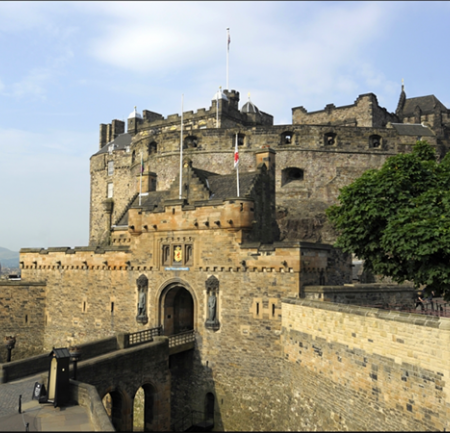
   Claire: Look! This is the castle where Scottish
   Kings used to live from the eleventh century.
   This is where Prince James was born and became
   James VI.

   Karine: Why are you talking to me about James VI?

   Claire: Because he was the son of Mary, Queen
   of Scots. She was Queen Elizabeth Ist’s enemy,
   England and Scotland were at war. Mary was put
   in jail by Elzabeth 1st, and she was beheaded later.

   Then her son James became James VI, King of Scotland.
   But when Elizabeth 1st died, she had no children,
   no heir. Her closest relative was Mary, so Mary’s
   son, James VI of Scotland, became James Ist of England
   in 1603.

   Karine: And this is why the British flag is made
   up of the crosses of the English and Scottish flags.
   But I don’t think my family is related to the Royal
   Family…. Shall we go to the Royal Mile? It’s this way.

       Visit Edinburgh's castle (with subtitles):
      https://www.youtube.com/watch?v=7WoCyufBDrA
   Claire: It’s tiring!

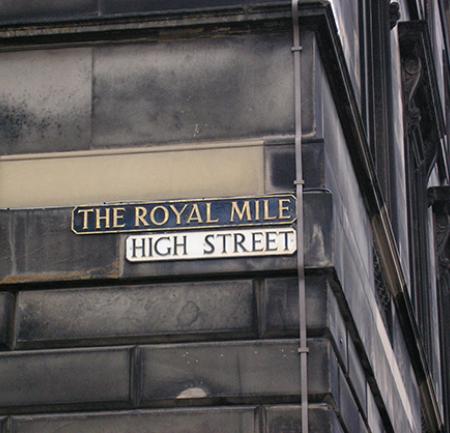
   Karine: Now, we’re going to visit the Royal Mile.

   Claire: What is it?

   Karine: It’s the name of a succession of streets
   that come down from Edinburgh castle to Holyrood
   palace. They were called the Royal Mile. You know
   one mile is 1,609.31 metres, but the Royal Mile is
   longer: 1,707.14 metres.

   Claire: This is why it’s called Royal, because it
   goes from one castle to another, but where is it?

   Karine: I think it’s nearby. Let’s go and see!

   Karine: This is the Royal Mile. Edinburgh castle is
   up here, and the other castle down there. I think my
   ancestor must have come here. We must ask and get
   information.


          Visit the Royal Mile (with subtitles):
   https://www.youtube.com/watch?v=h_5neQjoE8w
  Claire : Is this an Anglican or a Catholic church?

  Karine : Let me look at the guide-book for
  information! It is a cathedral. It was Catholic
  but it became Protestant in the XVIth century.
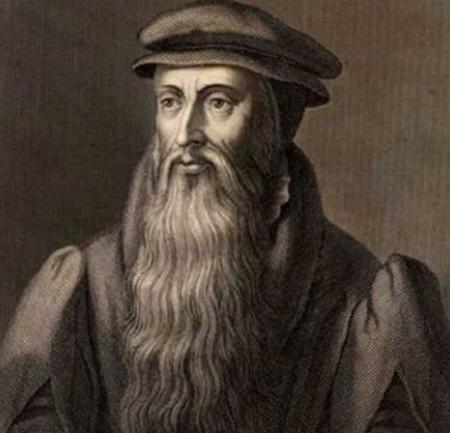
  The man who spread Protestantism in Scotland is
  very famous, his name is John Knox.

  Claire : And his house is still standing, a very
  old one.  Shall we visit it? This is it, his house.

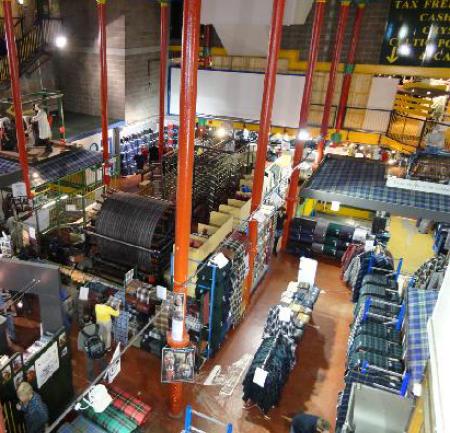
  Karine : This is a tartan museum, you know Scottish
  clothes. We could go in, show the painting, and ask
  if they know my ancestor’s family.

  Claire : No, that’s another subject, not today’s.


              Visit Saint Giles:
 https://www.youtube.com/watch?v=MW8Zp1Tfw6M
  Claire : So, Scottish men still wear kilts, don’t
  they?

  Karine : Yes, they do. Every family has its own tartan.

  Claire : What is the tartan?

  Karine : You noticed there were many different kilt
  colours, didn’t you?

  Claire : Yes, I did. Many, many…

  Karine : Look! There can be different patterns and
  different colours as well. This makes different
  tartans, every family, every clan has its own.

  Claire : So, if you have your family tartan, you can
  find your family ame, can’t you?

  Karine : That’s right, I took a catalogue to compare
  it with my painting.

       Do you want to know the history of the great kilt?
    Click on this link and don't forget the subtitles:

       https://www.youtube.com/watch?v=-jE__DYSM6U
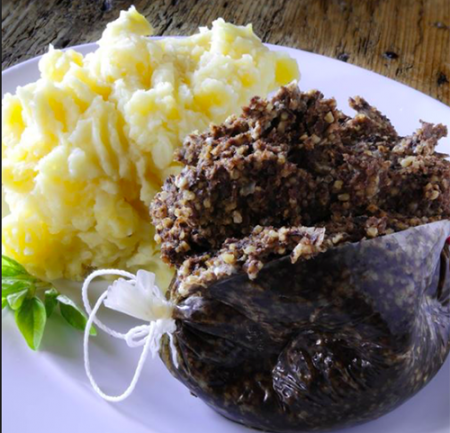
   Claire: I think the national Scottish meal is haggis.
   But do you know what it is?

   Karine: This is Scotland famous national dish. It is
   made of sheep’s pluck with spices in a sheep’s
   stomach.
   But before you eat your haggis, the tradition says
   that someone must recite a poem entitled «to a haggis».

   Claire : You make me feel hungry. I am going to order.
   What do you want?

   Karine : Not haggis, thank you.

   Claire: I’ll have it. This is haggis, do you want
   to try it?

   Karine: Just a little bit. It’s good, but spicy.

   Claire: I’m going to try. It’s good.

   Karine: For me. Thank you.

   Karine and Claire: Enjoy your meal.
   Claire: So, have you found your family tartan in
   the book? Have you compared it with your painting?

   Karine: I think this is the same one.

   Claire: I think so too. But what clan is it?
   The MacDonalds.

   Karine: Yes, I’m sure it is. The MacDonalds
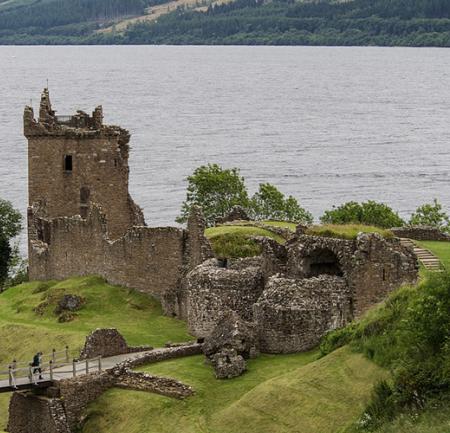
   used to live in Urquhart castle.

   Claire: This is a ruined castle, near a lake:
   Loch Ness.

   Karine: Yes it is. It’s in the North of Scotland,
   in the Highlands. The South is called the
   Lowlands, with Glasgow and Edinburgh. In the North,
   you have mountains, and the famous Highland games.
   Shall we go?

   Claire: Yes, I saw a poster about Highland games,
   like tossing the caber. But what is the town nearest
   to Loch Ness?

   Karine: It’s Inverness. Please, could you give me
   the train timetable?
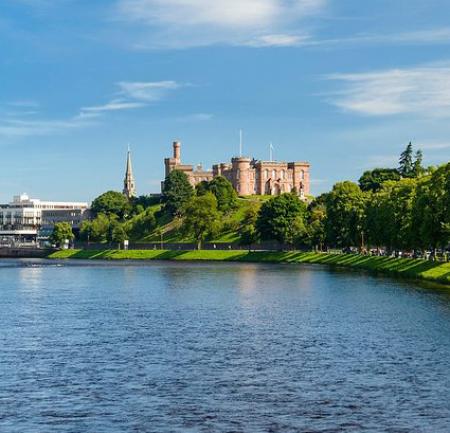
              In INVERNESS

  Karine: I’m impatient to see the castle where
  my family used to live.

  Claire: I would like to go to the hotel first.

  Karine: No, afterwards. Let’s take a taxi, it’s
  faster. The bus is too slow.

  Claire: But a bus is cheaper.

  Karine: Yes, it is. A taxi is more expensive,
  that’s true, but it’s faster, it’s better. Let’s go!
Karine : This is my ancestor’s castle, one
of the oldest castles in Scotland.
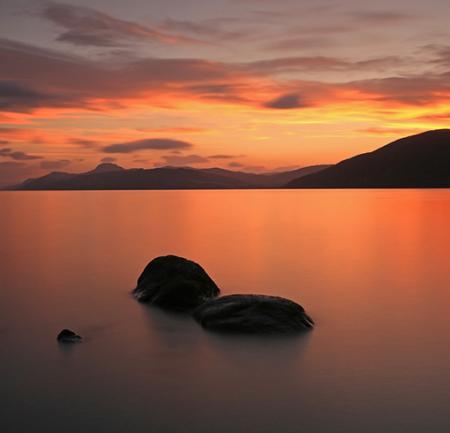
Claire : This is the world famous Loch Ness.
Karine : I’m disappointed, I thought it was
an outstanding castle, it’s not. It’s in ruins.
Claire : In Scotland, castles are very important,
including this one.
Karine : I’ve been told that my family, the
MacDonalds, won and lost the castle several times
during wars with the English. And they lasted for
two hundred years.
Claire : Let’s go and see the Loch.
  Claire : The Loch is forty kilometres long, and
  two hundred and thirty metres deep. It is the
  deepest lake in the United Kingdom.

  The temperature on the surface is twelve degrees
  maximum. But the deep waters are much colder:
  four degrees all year round. The Loch is twelve
  metres above sea level.

  Karine : In the old days, the monster was not famous.
  The first text that talks about it dates back to the
  6th century, Saint Columba came from Ireland to
  Scotland.

  He is said to have killed the monster with
  his Cross.


  Click on the link below to watch a programme
        about the Loch Ness monster
         (and with subtitles):
https://www.youtube.com/watch?v=0-lqkpMYIng
  Claire: When a road was built around the Loch,
  more and more people witnessed seeing the monster.

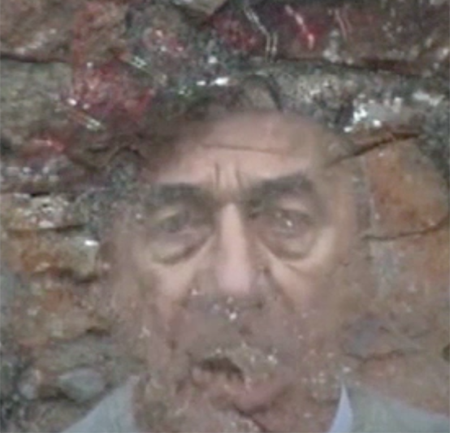
  Karine: I’m not afraid of monsters, what
  frightens me more are ghosts. Maybe my ancestor
  is somewhere around here.

  Claire: I’m not afraid of ghosts, I don’t believe
  in them. It’s getting dark, we’d better go.

  Karine: Look over there!

  The ghost: You have come to deliver me, thank you!
               Back to Karine's home


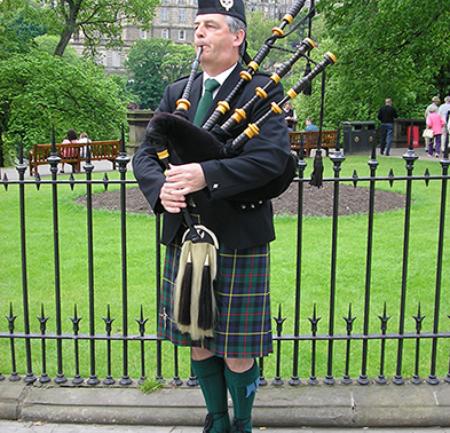
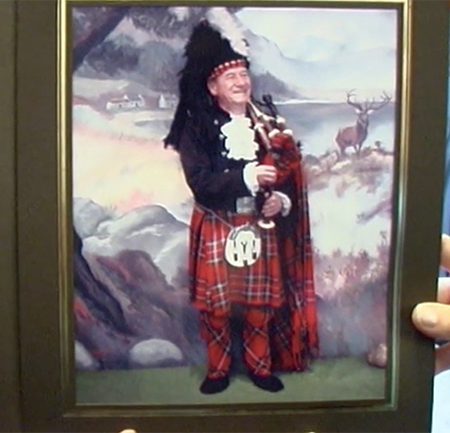
   Claire: Do you remember the painting? He looks
   different now.

   Karine: He is smiling now. Before he had a sad
   cold face. Now he looks happy.

   Claire: It’s different. On the other painting,
   he was holding a sword, now he’s playing the
   bagpipes. What does it mean?

   Karine: I think it’s a message. He’s happy and
   he is free. Free.


  I am sure that you do want to visit Scotland now,
           click below to plan your journey:
       https://www.youtube.com/watch?v=GRhqRnj2sY0